Why APHELAR™ Is More Than a Patch: The Value of a Proprietary Microstructured Platform
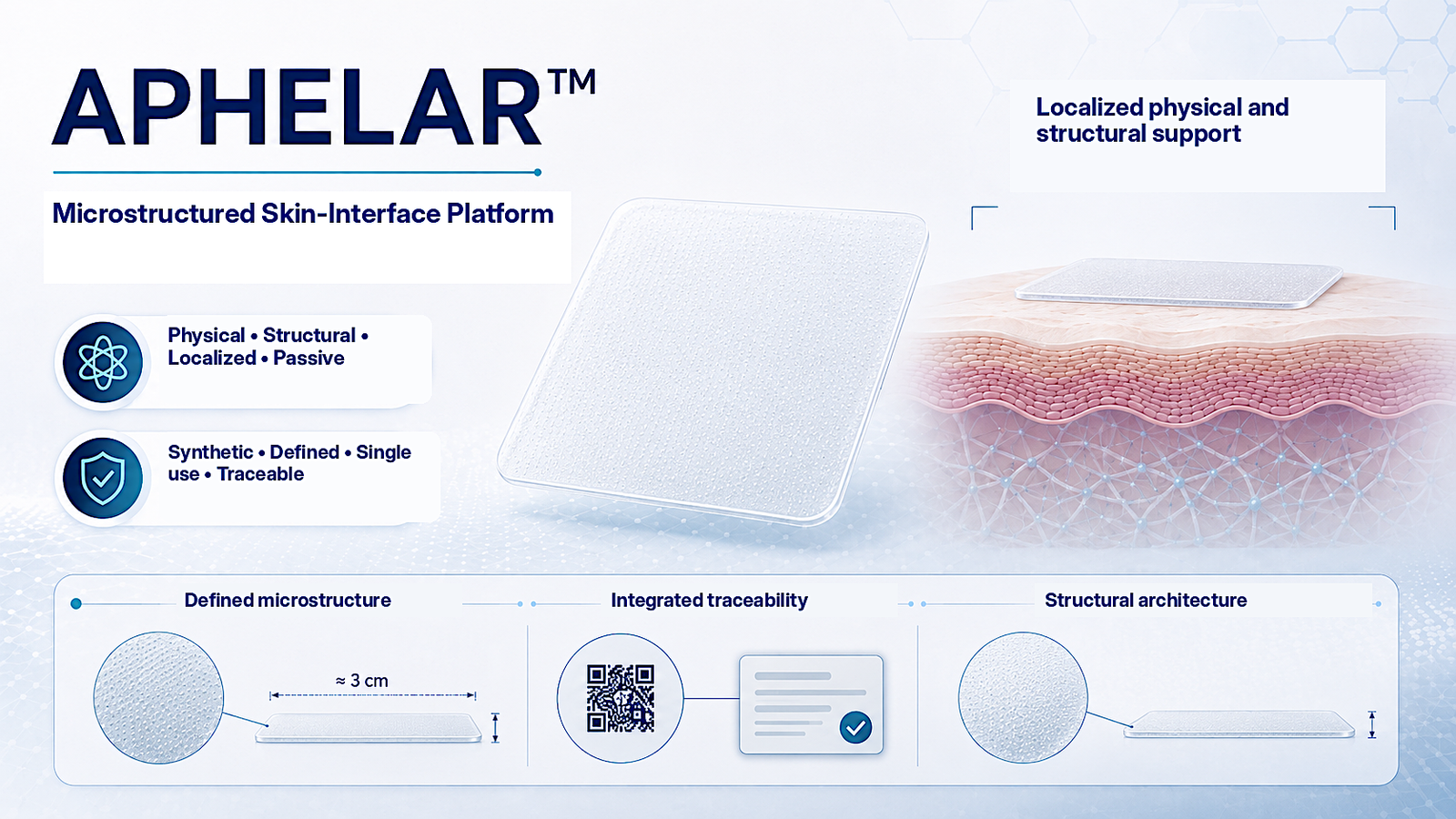
APHELAR™ Platform Architecture · Technical and Strategic Overview
A physical format can still be a platform asset
The easiest way to misunderstand APHELAR™ is to evaluate it only as a small physical patch. The visible unit is compact, but the technology behind it is layered: a controlled microstructure, a defined material architecture, manufacturing specifications, quality controls, lot identity and STIP™-enabled traceability. The commercial object is therefore more than a piece of material. It is a repeatable technology system expressed in a unit-sized format.
For investors, that distinction matters. Commodity products are usually valued around unit economics and distribution. Platform technologies can create value through know-how, repeatability, intellectual property, manufacturing discipline, data continuity and the ability to support additional controlled configurations without rebuilding the industrial foundation from zero.
The architecture is the product
APHELAR™ is organized around a simple thesis: the architecture is the product. Its identity is not assigned to one isolated molecule. It emerges from the integration of a hydrophilic structural matrix, structural lipid families, synthetic peptide motifs and a controlled microstructured geometry.
This integrated approach shifts the investment conversation away from ingredient cost alone. The relevant questions become: Can the architecture be specified? Can it be reproduced? Can batches be released against defined criteria? Can the identity of each lot be reconstructed? Can the same technical story be maintained across manufacturing, labeling, technical documentation and public communication?
Four sources of platform-level value
- Proprietary architecture: a defined combination of microstructure and material organization rather than a commodity presentation.
- Manufacturing know-how: process parameters, specifications and in-process controls that turn design into repeatable finished product.
- Regulatory engineering: product definition, intended purpose and operating principle designed to remain technically consistent.
- Traceability infrastructure: STIP™ links formulation, raw materials, lot, fingerprint, release and documentation.
Why compact can be strategically powerful
Compact products can support favorable logistics, straightforward handling and efficient distribution, but physical size is not the source of the platform thesis. The strategic value comes from concentrating sophisticated product architecture into a small, controlled format. This is why “small physical footprint, large platform value” is a useful way to frame APHELAR™ for sophisticated audiences.
The opportunity is not to make the patch sound more therapeutic. It is to make the underlying engineering more visible: defined microstructure, controlled material architecture, reproducible manufacturing, technical consistency and traceability.
The investment takeaway
APHELAR™ should be evaluated as a proprietary microstructured interface platform whose value is created across design, manufacturing, documentation and traceability. The physical unit is the delivery format of that architecture—not the full definition of the asset.
For investors seeking MedTech platforms with a clear technology core, the central question is therefore not “How much material is in the patch?” but “How much defensible architecture is embedded in the system that produces it?”