aphelar.com

APHELAR™

Microstructured Skin-Interface Platform

Physical, structural, and localized architecture developed on a synthetic, defined, and traceable material platform.

PASSIVE · PHYSICAL · STRUCTURAL · LOCALIZED · SYNTHETIC · DEFINED · MICROSTRUCTURED · SINGLE-USE · TRACEABLE
Localized physical and structural support through a brief, controlled and reproducible microstructured skin interface.
APHELAR microstructured skin-interface platform

A Clear Product Identity

What is APHELAR™?

APHELAR™ is a passive, synthetic, single-use microstructured skin-interface device. It integrates a hydrophilic structural matrix and a defined phospholipid-peptide material architecture within a controlled microstructured configuration.

Microstructure

Defined and reproducible physical geometry.

Material architecture

Controlled integration of matrix, lipid families, and structural peptide motifs.

Localized interface

Interaction concentrated at the application site.

Physical transition

Hydration and controlled material evolution during use.

Traceability

Identity, formulation, lot, and documentation connected through STIP™.

Intended Purpose

APHELAR™ is intended to provide localized physical and structural support at the skin interface through a brief, controlled, and reproducible microstructured interaction.
The product achieves its primary function through geometry, material organization, physical contact, and the localized behavior of its microstructured matrix. This function is physical and structural and does not depend on a primary pharmacological, immunological, or metabolic action.

Minimal-Intervention Microstructure

Fine microprojections for localized skin engagement

APHELAR™ uses a surface of solid, extremely fine, low-profile microprojections integrated into an almost transparent matrix. The geometry is designed to establish brief, controlled, localized skin engagement using only the dimensions required to create a reproducible physical interface.

Geometric height is a device design and manufacturing parameter and is not used as an equivalent of tissue-interaction depth. The configuration prioritizes the minimum physical intervention compatible with its interface function.

FINE MICROSTRUCTURE · LOCALIZED CONTACT · BRIEF INTERACTION · PASSIVE ARCHITECTURE

[Microstructure Geometry Interface]

Operating Principle

An integrated physical sequence

STAGE 1
Microstructured geometry

The product surface provides a distributed and defined geometry.

STAGE 2
Localized contact

The configuration establishes a controlled physical interface with the skin surface.

STAGE 3
Hydration

The hydrophilic matrix takes up moisture during the defined use window.

STAGE 4
Material transition

The microstructure progressively transitions from its initial configuration.

STAGE 5
Physical-structural interface

The material architecture remains integrated within a localized configuration.

STAGE 6
Completion

The interaction concludes as part of a single-use product.

GEOMETRY → CONTACT → HYDRATION → TRANSITION → INTERFACE → COMPLETION
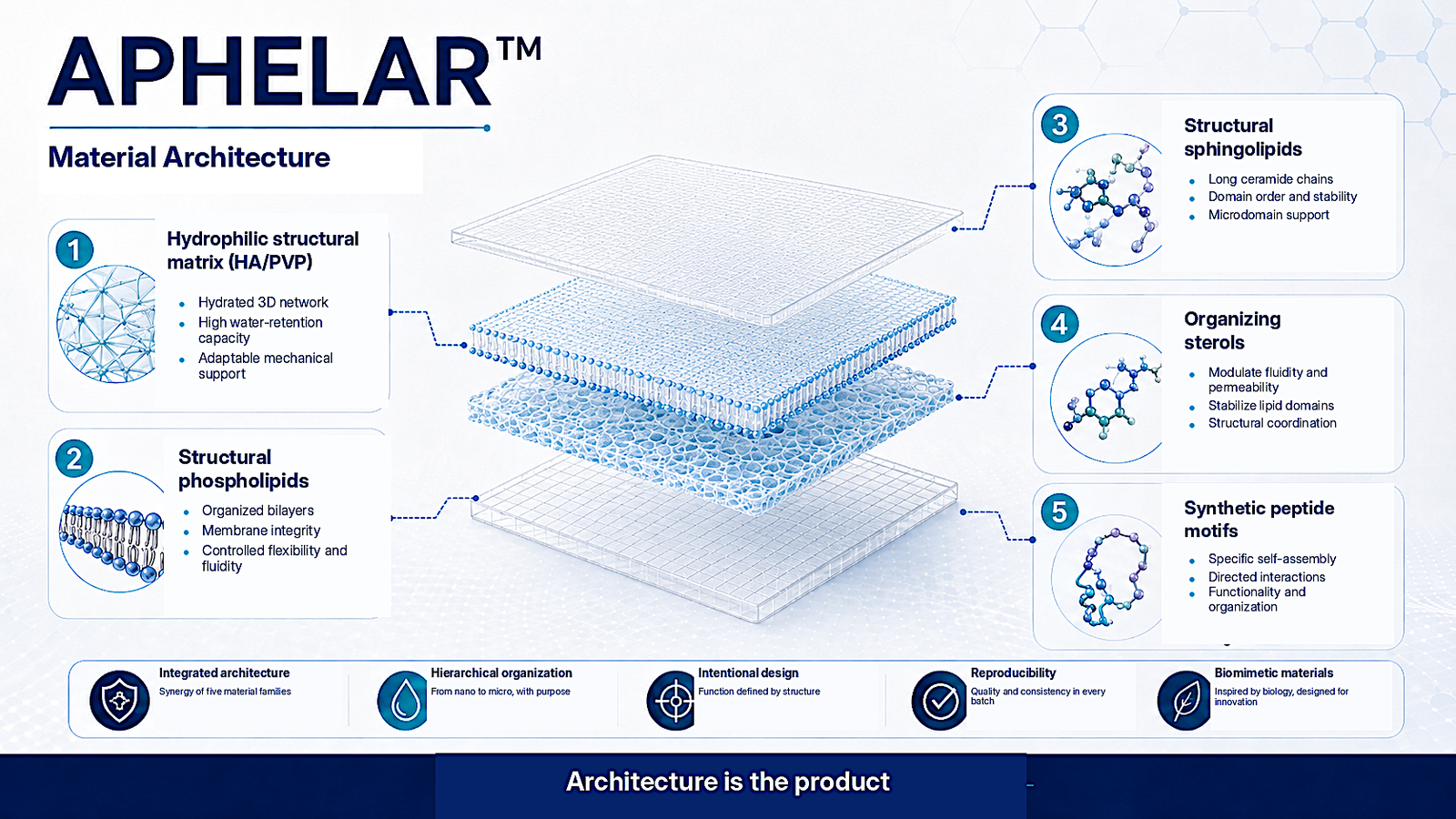
APHELAR material architecture showing matrix and lipids

Material Architecture

A defined multi-component platform

APHELAR™ is not defined by a single ingredient. Its identity derives from the organized integration of different material families forming one unified architecture.

Hydrophilic structural matrixGeometry, cohesion, hydration, and physical transition.
Structural phospholipidsOrganization and continuity of the material phase.
Structural sphingolipidsCohesion and order of the architecture.
Organizing sterolsMaterial stability and packing.
Synthetic structural peptide motifsInterface, coherence, assembly, topology, and matrix compatibility.
THE ARCHITECTURE IS THE PRODUCT.

A synthetic and defined architecture

APHELAR™ is built as a material platform independent of complex cellular sources. Its material identity is based on specified raw materials, controlled architecture, reproducible manufacturing, identified finished product, and lot traceability.

RAW MATERIALS → SPECIFICATION → ARCHITECTURE → MANUFACTURING → FINISHED PRODUCT → LOT → TRACEABILITY

Membrane and microdomain science

Biological membranes exhibit complex levels of spatial organization. Phospholipids, sphingolipids, sterols, and proteins can organize within dynamic regions known as microdomains.

PHOSPHOLIPID-PEPTIDE STRUCTURAL ARCHITECTURE INSPIRED BY MICRODOMAIN ORGANIZATION PRINCIPLES

Published Scientific Foundation

Peer-reviewed scientific lineage supporting the platform

APHELAR™ is developed within a peer-reviewed scientific program that has progressively examined phospholipoproteic architectures, membrane and microdomain organization, molecular stability, analytical reproducibility, ex vivo compatibility, and structured traceability.

No.Scientific PublicationScientific Contribution
1Cancers. 2025;17(10):1658.
doi:10.3390/cancers17101658
Phospholipoproteic platform architecture, purification, molecular characterization, and scalability.
2Biomedicines. 2025;13(6):1299.
doi:10.3390/biomedicines13061299
Phospholipid-rich architecture, preserved molecular fingerprints, structural stability, and reproducibility.
3Int. J. Mol. Sci. 2025;26(12):5444.
doi:10.3390/ijms26125444
Multistage monitoring framework, molecular quality control, immune profiling, and STIP™ architecture.
4Biology. 2025;14(8):953.
doi:10.3390/biology14080953
Real-time, label-free, non-cytotoxic functional stratification and reproducible ex vivo monitoring.
5Biomedicines. 2025;13(9):2101.
doi:10.3390/biomedicines13092101
Ex vivo traceability, batch comparability, kinetic documentation, and evidence architecture without clinical exposure.
6Int. J. Mol. Sci. 2026;27:2305.
doi:10.3390/ijms27052305
Integrative mechanistic synthesis of membrane organization, microdomains, spatial signaling, and structural interfaces.
7Pharmaceutics. 2026;18:847.
doi:10.3390/pharmaceutics18070847
Proteomic stability, analytical reproducibility, processing robustness, and short-term ex vivo cellular compatibility.

Technical-Regulatory Profile

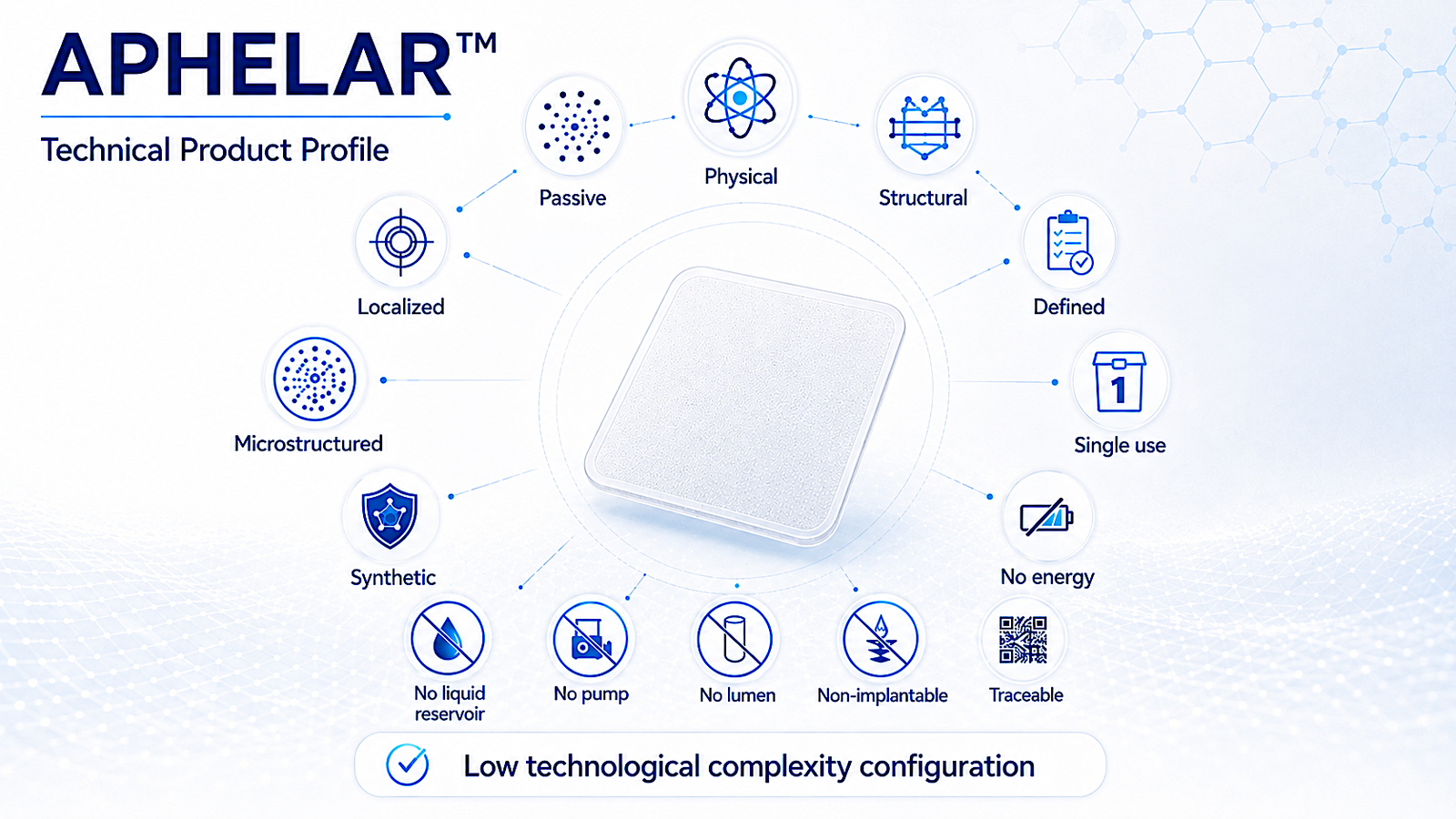
A clearly defined technical configuration

The product technical identity remains constant and can be recognized within frameworks that provide proportionate administrative pathways.

OperationPassive
Primary actionPhysical & structural
Functional siteLocalized skin interface
External energyNone
Permanent implantNo
Vascular accessNo
CompositionSynthetic & defined
TraceabilityProduct, lot, doc linked
APHELAR technical product profile

Production & Control Architecture

Safety by Design

The APHELAR™ control architecture focuses on parameters inherent to a physical interface device: materials (identity and purity), geometry (microstructured configuration), biocompatibility, microbiology, stability, packaging, manufacturing, and traceability.

Controlled Manufacturing

From raw material to finished unit. APHELAR™ maintains a reproducible and fully reconstructible manufacturing chain.

RAW MATERIALS → SPECIFICATIONS → ARCHITECTURE → MANUFACTURING → FINISHED PRODUCT → RELEASE → LOT → STIP™

STIP™ Traceability

STIP™ is the cross-functional documentation layer of APHELAR™ and maintains continuity across product, configuration, formulation, raw materials, lot, fingerprint, release, and documentation.

PRODUCT → CONFIGURATION → FORMULATION → RAW MATERIALS → LOT → FINGERPRINT → RELEASE → DOCUMENTATION

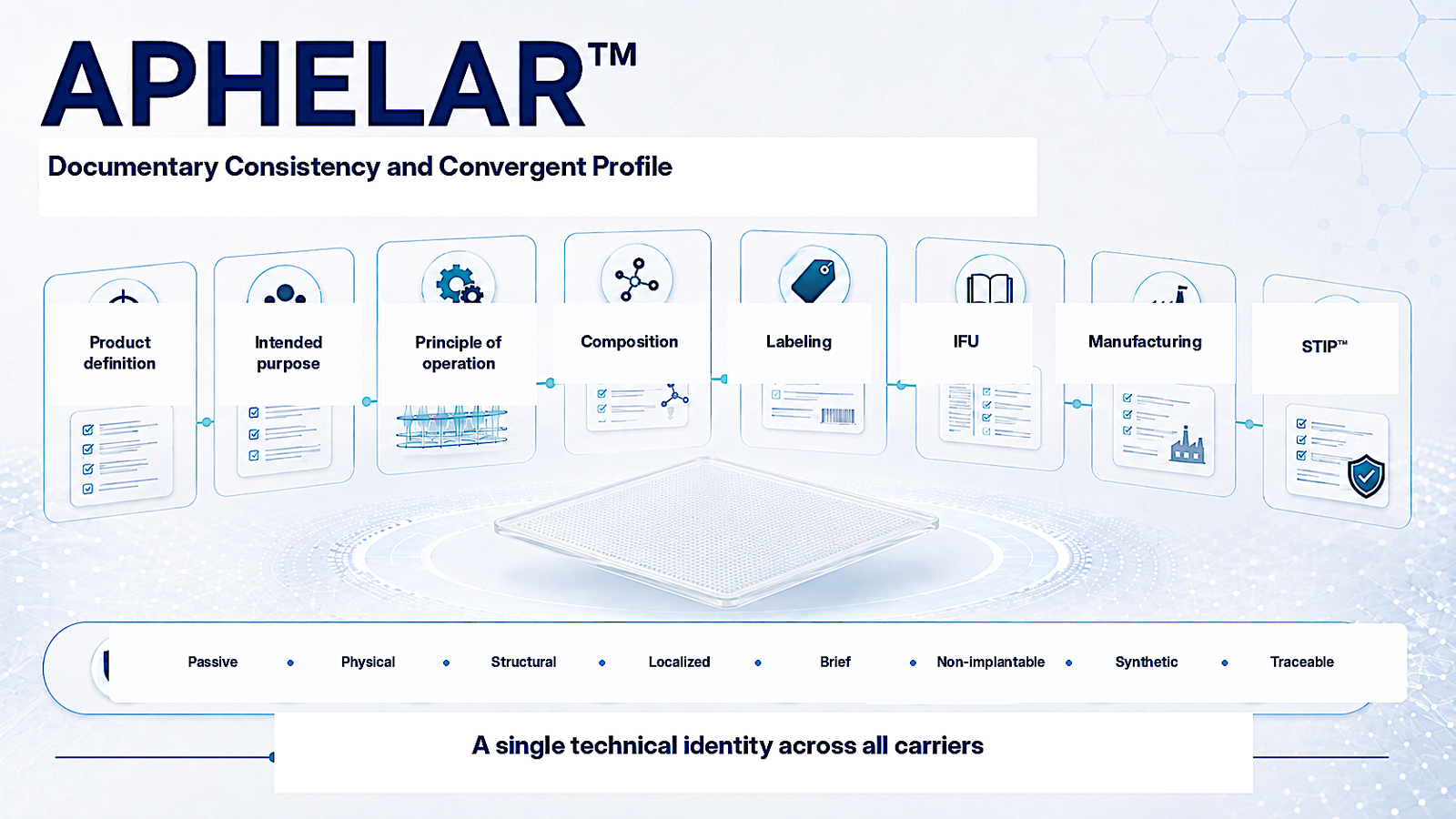
Documentary Consistency

A single technical identity across all carriers

APHELAR™ maintains the same functional identity across product definition, intended purpose, composition, labeling, instructions for use, public information, technical documentation, and traceability.

APHELAR documentary consistency
SAME PRODUCT · SAME INTENDED PURPOSE · SAME ARCHITECTURE · SAME MANUFACTURING · SAME TRACEABILITY
Scroll al inicio